



Intervention in a lithium-ion battery fire means the set of detection, containment and suppression actions taken to stop or slow thermal runaway before it spreads to neighboring cells. Because lithium-ion cells store both fuel and, effectively, their own oxidizer inside a sealed casing, a battery fire behaves differently from a conventional fire it can reignite after being extinguished, and it cannot always be fully “put out” in the traditional sense. For manufacturers assembling battery packs, understanding this behavior is not optional; it determines how a production line, a storage area, or a testing station must be designed.
Why Lithium-Ion Battery Fires Are Different
A lithium-ion fire is driven by thermal runaway: an internal chain reaction in which heat generation inside the cell exceeds the rate at which it can dissipate. Once a cell crosses its critical temperature, it releases flammable gases and heat rapidly enough to trigger the same reaction in adjacent cells. This is why a single defective or damaged cell in a pack can escalate into a cascading, multi-cell fire within seconds.
Common triggers of thermal runaway in a manufacturing or assembly environment include:
- Mechanical damage (crushing, puncture, or deformation during handling or welding)
- Overcharging or over-discharging beyond the cell’s rated limits
- Internal short circuits caused by manufacturing defects or contamination
- Exposure to excessive external heat, including improperly controlled spot welding or soldering
- Cell aging and degradation from repeated charge/discharge cycles
Warning Signs Before Ignition
Early detection is the single most effective intervention, because it allows isolation before thermal runaway begins. Operators and automated monitoring systems should watch for:
- Swelling or bulging of the cell casing
- Unusual heat at the cell or pack surface
- Hissing sounds or gas venting
- A sharp, acrid odor associated with electrolyte off-gassing
- Visible cracking, dents, or casing damage
Any cell showing these signs should be isolated immediately in a non-combustible, ventilated area, away from other cells and flammable materials — a minimum safe separation distance is generally recommended for quarantined or damaged cells.
Response Strategies: Defensive, Offensive and Non-Intervention
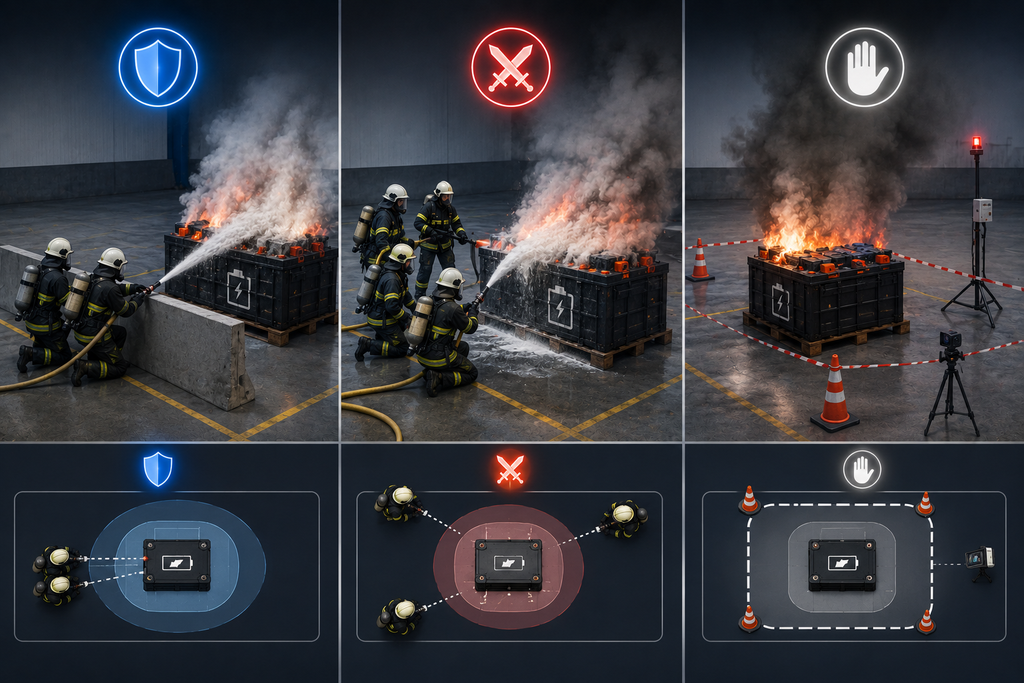
Fire safety guidance for lithium-ion incidents generally frames response around three strategic options, and the correct choice depends on scale, cell format, and whether the fire is contained:
Non-intervention (monitor and contain): For a fire in a controlled, isolated location with no risk of spread, allowing the reaction to burn out under observation while preventing propagation to nearby cells or materials can be safer than direct intervention, since full suppression may not be achievable and reignition is common.
Defensive response: Establishing a safe perimeter, applying sustained cooling (typically large volumes of water) to surrounding cells to prevent propagation, and controlling runoff and ventilation, without attempting to fully extinguish an active cell fire.
Offensive response: Direct suppression using extinguishing agents suited to electrical and chemical fires, combined with active cooling reserved for situations where the fire is small, contained, and can be safely approached with appropriate personal protective equipment.
Suppression Methods Used in Practice
No single agent instantly stops a lithium-ion fire, because the reaction is self-sustaining. In practice, facilities combine methods:
- Water and water mist: The most widely used approach for its cooling capacity; large volumes may be required to bring cell temperature below the runaway threshold, and water is not effective at cutting off the internal chemical reaction itself.
- Class D and specialty agents: Used where lithium metal is exposed, though most lithium-ion battery fires are primarily electrolyte and gas fires rather than metal fires.
- CO2 and clean agents: Can suppress surface flames quickly but generally cannot cool the cell core enough to prevent reignition on their own.
- Fire-rated containment (bags, cabinets, immersion tanks): Increasingly used in production and storage settings to physically isolate a thermal event, limit oxygen and heat exchange with the surroundings, and contain any runoff or gas release.
Because reignition can occur hours after a fire appears extinguished, thermal monitoring of the affected cell or pack should continue well after visible flames are gone.
Prevention: The First Line of Intervention
In a production environment, the most reliable “intervention” is preventing thermal runaway from starting in the first place. This includes:
- Tight process control during cell sorting, spot welding, and pack assembly to avoid mechanical damage or excessive heat input to cells
- Automated voltage, internal resistance, and temperature monitoring at each production stage
- Physical separation between cell storage, assembly, and testing zones
- Dedicated fire-rated storage and quarantine cabinets for damaged, rejected, or out-of-spec cells
- Real-time gas and smoke detection integrated into the production line
- Documented emergency response procedures specific to lithium-ion incidents, not generic fire procedures
Building Fire Safety Into the Production Line
For battery pack manufacturers, fire risk management works best when it is engineered into the line itself rather than treated as an afterthought. This typically means combining upstream quality control (accurate cell sorting and classification to catch weak or defective cells before assembly, and controlled spot welding to avoid excess heat input) with downstream containment isolation cabinets, automatic suppression, and monitoring at storage and testing stations. logiCAN’s iCANsecure fire extinguish cabinet is designed for exactly this role: providing dedicated, monitored containment for battery cells and packs during storage, testing, or quarantine within a production facility.
Frequently Asked Questions
What makes lithium-ion battery fires hard to extinguish?
Because the cell contains both fuel and an internal oxidizer, the reaction can sustain itself even without external oxygen, and it can reignite hours after appearing extinguished.
What is thermal runaway?
Thermal runaway is a chain reaction inside a battery cell where internal heat generation exceeds the rate of heat dissipation, causing rapid temperature rise, gas venting, and potential ignition or explosion.
Can water be used on a lithium-ion battery fire?
Yes water and water mist are widely used for their cooling effect on surrounding cells, though large volumes may be needed and water alone does not stop the internal chemical reaction inside an already-runaway cell.
How can manufacturers prevent battery fires during production?
By combining strict process control during cell sorting and welding, real-time voltage/temperature/gas monitoring, physical separation of storage and assembly zones, and dedicated fire-rated containment for damaged or quarantined cells.
Is reignition a real risk after a lithium-ion fire is extinguished?
Yes, reignition is a well-documented risk, which is why affected cells or packs should be monitored for an extended period after the fire appears out.

Leave a Reply